by Rod Nikkel, Village Missionary serving in Golden Prairie, SK
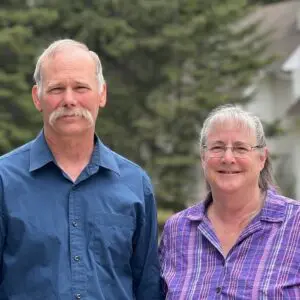 In the small towns and rural communities where Village Missionaries serve, we are often regarded as “the community pastor.” My wife and I have served in the small town of Golden Prairie, Saskatchewan, since 2019, long enough to be known by reputation at least. As a result, I am frequently called on by people from the community when one of their relatives dies. Sometimes I know the deceased or family members, but even strangers call on me to assist with funerals and graveside services.
I credit my home church pastor, Don Ford, for teaching me the basics of funerals and graveside services from his extensive experience. His input has proven very helpful in the funerals I have conducted, especially when I didn’t know the deceased or even the family.
Meeting with a Grieving Family
It generally starts with a phone call from a family member. I always offer my condolences first. “I’m so sorry to hear about your loss.” Or I might say, “That’s very hard. I’m sorry to hear that your brother/mother/uncle passed away.” Then I set up a meeting with as much of the family as possible.
Some meetings are straightforward. One family told me exactly what they wanted me to do. The man who died had planned out his funeral completely.
A more common scenario is that the family has no idea what to do. For example, a family from two hours away called me because they couldn’t find anyone else to do their mother’s funeral on short notice. I knew one of the sons by sight and name only and had never met the deceased or the rest of the family. As soon as we introduced ourselves, they said, “We don’t know anything about planning a funeral.” They looked to me to lead the discussion and offer them ideas on how things might go.
 I needed to get the official information about their loved one – her official name, what she liked to be called, her family details, and her basic life history. But more importantly for the family, I wanted them to tell me their favorite memories of her, especially humorous incidents and family stories.
They told me stories about things she loved to do, what she was known for, hardships she overcame, and how she served others and volunteered in the community. The discussion and storytelling brought much laughter along with tears. It was helpful and healing for them. For many families, recalling stories opens communication and starts the healing process.
The other reason I want to hear these stories is to help me build the service and my message around the person. This speaks to the mourners and makes the service a positive memory for them.
A Funeral Planning Checklist
As the stories are tapering off, I ask what the family wants to include in the service. Many people don’t know, so I have a checklist I go through with them:
- Opening words
- Scripture: is there a favorite verse they want read?
- Eulogy: who will do it and any suggestions for the content?
- Music: congregational singing, performance singers, a prelude and postlude?
- Message: I always do one. I assure them it will be short unless they want more.
- Pallbearers and ushers
- Do they want a viewing?
- Announcements
As we go through the checklist, the family discusses what they want and what they think the deceased would have wanted. At the end of the meeting, I can feel their sense of relief as the plan for the service is in place. In most cases, sharing about their loved one has brought them closer to each other in this difficult time.
The Funeral Message
 The message I give in a funeral service is built around the information I gathered about the person. I share the message after the eulogy, so I don’t repeat what has already been said. I aim for no more than ten minutes, although the shorter the message, the more work it takes to prepare!
Whether the person followed Christ or not, the primary idea I want to give is the hope we can all have in Jesus. I give a clear, simple gospel message, without “churchy” terminology that people may not understand. I let my listeners know that we all face death and that we need to be certain we are right with God. Then I point them to Jesus, through whom we can have that right relationship with God.
I don’t preach or pray the person in or out of heaven. I leave that to the One who is the perfect and right judge. But people at a funeral are more open to hearing about salvation than at other times. I have a list of Bible passages I often use,[1] scriptures that point both Christians and non-Christians to the hope found in Jesus.
Graveside Services
I generally plan short graveside services, no longer than 10 to 15 minutes. Saskatchewan winters are cold; at minus 20℃, people don’t appreciate long graveside services! Once again, my goal is to point people to where to find hope. I try to personalize the service to the person as much as I can. A message of about 5 minutes is ideal. I follow it with a simple committal and finish with prayer. For Scripture, I especially like 1 Thessalonians 4.13; 5.23-24, and 2 Corinthians 4.16-18. For people who are not believers, I often select Ecclesiastes 7.2-4 because it points to the fact that we all face death and need to carefully consider our own eternity.
Last summer, I had the opportunity to do a graveside service for a man in our community who died without any family and without leaving a will, which made things complicated. Since our church used to own a local cemetery, I was contacted to help with details such as arranging the burial plot and finding pallbearers. I put out the word, and some townspeople – including four from our church – came to inter this man. Doing his graveside service allowed me to connect with people in our town who have nothing to do with any church. The man’s closest friend was happy for me to give a brief message and prayer before the coffin was lowered.
An Honor and an Opportunity
 These days, more people are choosing not to have any kind of service. As kindly as I can, I encourage people to hold at least a simple memorial for the sake of family and friends. It gives a sense of closure, and as people visit together after the memorial, they connect more deeply, and healing begins. Furthermore, when I come alongside grieving people, I can make significant connections and build trust, opening the door for conversations about God and his kingdom.
Any time I am called on to assist with a funeral or graveside service, I consider it an honor and a significant opportunity to bring the gospel of Jesus Christ into the lives of grieving people.
[1] Thessalonians 4.13-18, 2 Corinthians 4.16-18; 5.1-8, John 1.12; 3.16; 8.34-36; 11.21-27;14.1-6, Psalm 23; 46.1-3.